First-Party Data for Manufacturing SEO: How Original Technical Evidence Builds Authority
A product page that could be pasted onto a competitor’s site with the name swapped out is not evidence of expertise. Manufacturers usually have information competitors cannot copy without doing the same work: measurements, process choices, application failures, test records, and the judgment of people who build the product. First-party data is that material. Used carefully, it makes a page more useful and harder to fake. It does not force an AI system to cite you, and it does not come with a public “information gain score.”
Google’s guidance on helpful content asks whether a page shows first-hand knowledge and whether a reader leaves able to do something. That is the standard worth using. Originality is a way to meet it. Rankings and citations still depend on the rest of the site, the competition, and systems you do not control.
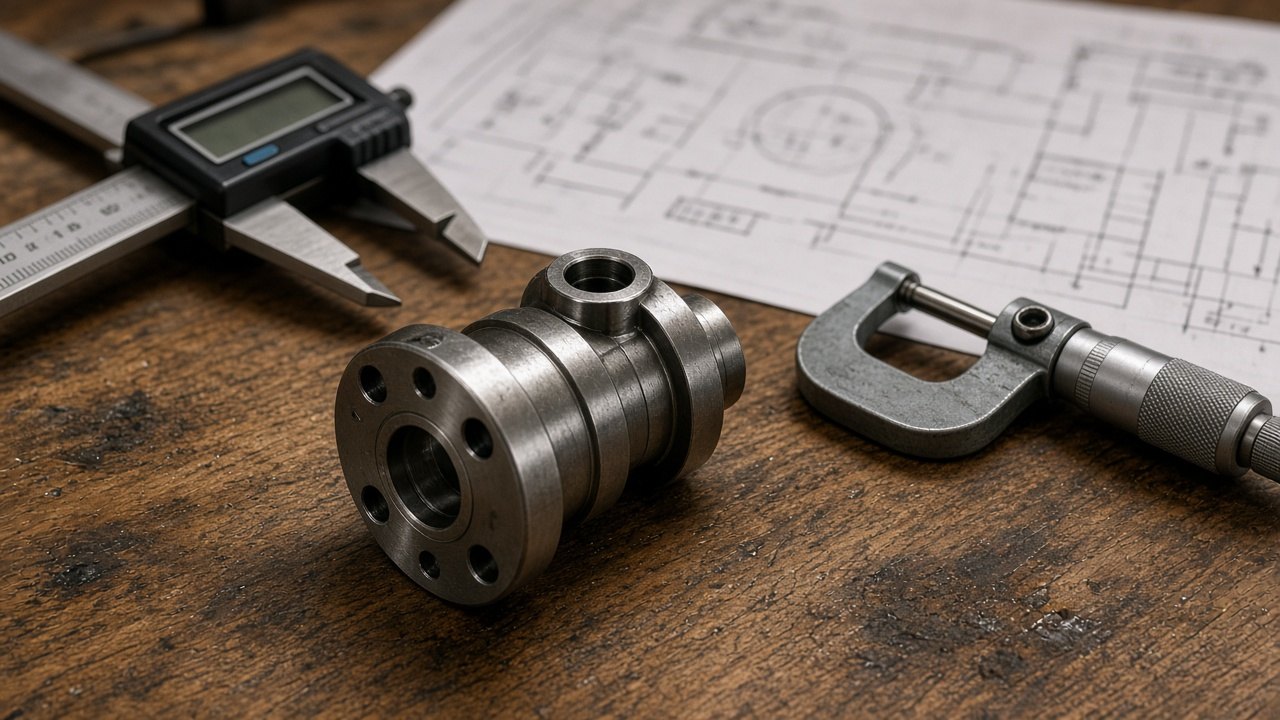
Editorial image for this article. Not a photograph of a client facility or a client project.
What first-party data means in a plant
First-party data, in this context, is information your company created or measured. It includes a dimension you checked, a cycle time from your cell, a failure you documented in the field, a photograph of your fixture, and an explanation from the engineer who designed the process. It is not the same thing as personal data about website visitors. Analytics and CRM records are also first-party, but this article is about technical evidence you might publish, not about ad targeting.
The useful test is simple. Could a writer who has never seen the part produce this sentence from a public brochure and a thesaurus? If yes, it is not evidence. If the sentence depends on a measurement, a drawing, or a person who did the work, it is a candidate for the page, after you decide what is safe to release.
Evidence, owned facts, public facts, and rewrites
Keep four piles separate so the page does not blur them.
Original technical evidence. A test you ran, a measurement record, a process photograph, an application note from your own installation.
Company-owned information. The part number, the option list, the lead-time policy, the plants you operate. You own the statement even when it is not the result of a lab test.
Public facts. A standard’s number, a material designation, a regulation. You may cite them. You did not create them, and you should not imply that you did.
Generic rewritten content. A paragraph that restates a supplier’s brochure or a competitor’s page in new adjectives. It adds no observation.
“Information gain” is a useful editorial idea: the page should add something the reader did not already have. It is not, in any public Google documentation we rely on, a score you can look up or optimize as a confirmed ranking factor. Do not brief a team to “increase the Information Gain Score.” Brief them to add a checkable observation, and to say where it came from.
Source material that is actually worth publishing
The strongest material is usually already in the building. Verified test results, with the method and the date. Measurement records that match the drawing. Engineering diagrams you are allowed to show. Production photographs of real fixtures, not a stock image presented as the customer’s line. Application notes from installations you can describe without breaking a confidentiality agreement. Interviews with a named specialist whose role is real, quoted only after they have approved the words.
A case study belongs in this list when the customer has agreed to the story and the numbers are the ones you can document. The MONTAGSPECSTROY case is an example of published website and SEO work for a construction and engineering company. It is not a template you copy numbers from, and it is not proof that original content produces a specific ranking change.
Weak substitutes are easy to spot. A stock photo labeled as “our CNC cell.” A test result with no date and no method. A quote attributed to “a leading engineer” who does not exist. Those are not first-party evidence. They are claims dressed as evidence.
Turning engineering knowledge into pages
Pick one product family and one job the page must do. A product page answers “what is this, and does it fit?” An application guide answers “where is this used, and where is it a mistake?” A comparison answers “which of our variants, under these conditions?” A technical article answers a question your application engineers hear on calls.
Move a fact into the format that matches the job. A set of bore sizes and seals belongs in a comparison the buyer can scan. A sequence for aligning a coupling belongs in numbered steps. A judgment about why a cheaper seal failed in a hot oil application belongs in a paragraph that states the fluid, the temperature, and the limit of what you observed. Semantic chunking is the organization step: one topic per section, specifications next to the claim they support.
Technical content work is how that material becomes a page a salesperson can send. The site structure decides whether the page sits on the right product and application URL instead of in an unlinked news post.
Document the origin, the date, the method, and the limit
A technical claim should carry its paperwork in public language. Origin: internal test, supplier datasheet, or field report. Date: when the measurement was taken, or a clear “current catalog” if the fact is a specification you maintain. Method: the instrument, the standard, or the condition, in words a buyer can follow. Limitation: the sample size, the fluid, the duty cycle, or the sentence “we have not tested this combination.”
You do not need a laboratory paper on a product page. You do need enough that a skeptical engineer can see you are not inventing the number. “Tested at 80 °C ambient, mineral oil, 500 hours, three samples, March 2026” is a different statement from “excellent heat resistance.” If you cannot publish the method because it is confidential, do not publish the superlative that depends on it.
Google’s helpful-content guidance makes the same point for reviews: say what was tested, what the results were, and how the test was run, and show evidence of the work where you can. Manufacturing pages deserve the same habit.
Photographs and other evidence
A photograph supports trust when it shows the thing the sentence is about. A picture of the fixture, the wear surface, or the measurement setup lets a reader see that the note is grounded. Caption it. Say what is in the frame and what is not. Do not caption a general workshop photo as a specific customer’s line.
Drawings help when the geometry is the question. Crop or simplify them so you are not publishing a full manufacturing pack if that pack is controlled. The page can state the interface dimensions a buyer needs and keep the rest on request.
The images on this website’s articles are editorial illustrations for the topic. They are not photographs of client plants, and they are not evidence in the sense this section describes. Evidence is material from the manufacturer’s own work.
What you should not publish
Original does not mean unrestricted. Before a fact leaves the building, ask whether it exposes a customer’s name or site without permission, a proprietary process, a price that sales did not agree to publish, export-controlled technical data, or personal data about employees. When the answer is yes, publish the lesson at a level that does not identify the sensitive detail, or do not publish it.
Customer identities stay out unless the customer has approved the wording. Intellectual property stays out when the drawing is the product. A “anonymized” story that still names the unique machine and the city is not anonymized. Have engineering and, where needed, legal review the page. Marketing should not be the only reader of a test claim.
A workflow for collecting and releasing technical information
Inventory. Ask application engineering, quality, and sales which questions repeat, and which files already answer them.
Classify. Mark each item as publishable, publishable after redaction, or internal only.
Choose one family. A single product line produces a better page than a tour of the whole catalog.
Record provenance. Origin, date, method, and limitation, in a note the writer cannot detach from the number.
Draft in the page’s structure. Direct description, specifications, application, limits, and the next step.
Review. The person who owns the data signs off. Unsupported sentences come out.
Maintain. When the design changes, the page changes. An outdated test is a false claim.
This is slower than rewriting a brochure. It is also the only way the page contains something a competitor cannot invent in an afternoon.
How to judge whether the page was useful
Look at more than one number. Search visibility for the specific queries the page was written to answer. Qualified inquiries that mention the product, the application, or the limit you documented. Time on the page is a weak signal by itself. Feedback from sales and engineering is a strong one: are fewer calls asking for a specification that is now on the page, and are the remaining calls more serious?
Do not promise that original information will be cited by an AI product. Originality can make the page more useful and more clearly yours. Citation is a separate decision made by systems that change. Google’s AI features documentation says there is no special markup that guarantees inclusion, and that indexing itself is not guaranteed.
Questions from manufacturing teams
Is a rewritten supplier datasheet first-party content?
No. The supplier created those figures. You may quote them with attribution. Your first-party contribution starts where you add a measurement, an application limit, or a process observation of your own.
Do we need a laboratory to publish anything?
No. A documented field failure, a measured installation dimension, or a clearly sourced catalog specification can be enough. State the method at the level you actually have. Do not imply a lab study you did not run.
Will original pages rank because they have “information gain”?
Treat information gain as a writing standard, not as a published score. Pages that add checkable knowledge are more useful. Usefulness is not a ranking guarantee.
Can we show customer equipment?
Only with permission, and only to the extent the customer agreed. Otherwise describe the application and omit the identifying details.
Who approves a technical claim?
The person who owns the data. Marketing can structure the page. Marketing should not invent the number.
A practical close
Audit one product line for sentences that any competitor could have written. Replace the weakest of them with a sourced observation, or delete them. Record where the observation came from. That is how original technical evidence becomes authority a buyer can check, rather than a slogan about expertise.
The content engineering service is built around that constraint: specifications and applications enter the page only when you can verify them.
Publish only what engineering can verify
Original technical evidence is useful when the source, date, method, and limits stay attached to the claim.
Organize manufacturing product pages into clear technical sections. Semantic chunking helps buyers and search systems read specifications, applications, and limits.
How manufacturers build a consistent public identity with relevant mentions, links, and third-party references, without promising AI recommendations.
Distribute technical manufacturing content for high-intent queries and qualified inquiries. Traffic alone is an incomplete measure of performance.