Laser Made: How a Full-Cycle Laser Cutting and Furniture Manufacturer Replaced Two Unstructured Landing Pages With Two Purpose-Built Websites and Five Years of Continuous Digital Growth
Five years of structured digital work turned two broken WordPress landing pages into two working websites: one for B2B production clients, one for retail decor buyers.
Overview

Laser Made: Five Years, Two Websites, One System That Still Works
Laser Made is a full-cycle production company working with wood, acrylic, MDF and metal. In 2019 the business had two slow, unstructured WordPress landing pages and no clear way for visitors to understand what it actually made. Over five years the site was rebuilt on Drupal, split into a B2B corporate platform and a B2C decor store, and supported by SEO, PPC, content and social media working together.
Ongoing monthly engagement without a fixed end date, cited in the source as evidence of a system that kept working rather than a short campaign.
Separate corporate site (B2B production) and online store (B2C decor retail).
Replaced the original single, unstructured landing page with a navigable, material and process based structure.
Manufacturing Profile
Laser Made operates its own production facilities with an in-house team. Confirmed operations include laser cutting, milling (including 3D milling and CNC facade work), painting and assembly. The source data describes this as a full production cycle rather than a single isolated process.
Custom furniture (wardrobes, kitchens, bar counters, wine cellars), decorative screens and partitions, interior wall panels, outdoor advertising structures (illuminated letters, lightboxes, signs, plaques, stands, pylons and roof installations), POS and retail equipment (bar counters, glass display cases, retail shelving), and decor items such as radiator screens and stained-glass elements. Souvenir products are also mentioned in the general description.
Wood, acrylic, MDF and metal are named directly in the source description. The expanded material-processing structure built into the site adds plywood, plastic, PVC, composite, polycarbonate, PET, paper, cardboard, felt, fabric, leather and rubber, 15 categories in total.
Retail spaces, exhibitions and trade stands, offices, restaurants and food courts, hotels, and private homes (decor). Commercial B2B applications include advertising and signage for other businesses. Consumer applications are served through the DecorTrend retail store.
Business Challenge
As of 2019, the company digital presence was two WordPress landing pages, both slow and without a clear structure. Multiple business lines (design, production, equipment, services) were combined on one page.
A visitor could not tell what the company actually did. There was no portfolio or case-study material to build trust. Paid search spend was not producing results, and social media activity had no defined strategy or measurable outcome. SEO was effectively not being done.
Give the business a digital structure that clearly separates the B2B production offering from a B2C retail line, build organic visibility for the specific materials and processes the company actually performs, and turn paid advertising and portfolio content into a working lead source. No fixed numeric KPIs are stated in the source data for the start of the project.
Niche Segmentation
B2B Manufacturing, Custom Fabrication (Laser Made)
The corporate site covers the core production business: material processing, outdoor and interior advertising, POS and retail equipment, and custom furniture and decor manufactured to order. The audience is other businesses commissioning custom production work.
Structure and content organized around the specific material, process and application (2,000+ keyword semantic core), supported by a 200+ project portfolio and PPC campaigns targeting commercial buyers.
Digital Architecture
Two Drupal-built websites (Laser Made, Decor Trend), Jivo live chat for on-site messaging, Google My Business for local search presence and reviews, and Google Ads for paid search. Contact routes include WhatsApp and Telegram alongside on-site forms.
Laser Made: 27+ sections built around 15 material-processing categories, 7 outdoor-advertising sections, interior advertising, POS and retail equipment, screens, furniture and decor, and a press-center and client-resources area.
Decor Trend: a standalone e-commerce structure for finished decor products. The specific sub-page breakdown is not detailed in the source data.
A 2,000+ keyword semantic core clustered by individual material, process and application, rather than a small set of generic head terms. The source page references a dedicated site information-architecture diagram, confirming a deliberately mapped structure rather than an organic page list.
Marketing Strategy
Semantic research and keyword clustering (2,000+ queries), content written per service and material, a blog built from client interviews (roughly 30 minutes of interview per 2,000-word article, starting with 10 to 15 foundational articles then 2 to 4 per month), a 200+ project portfolio, technical performance work (desktop load time 1.5 to 2s, mobile 2.5 to 3s, Google PageSpeed score 85 to 90), link building combining free guest posts with paid placements in industry directories and media, and Google My Business setup for local SEO.
Two form types are used: a short name-and-phone form on the homepage for fast lead capture, and an extended form (service type, material, timeline) on service pages for qualification. A price calculator (material and size to estimated price) is also available. Jivo live chat accounts for roughly 15 to 20% of leads, on the condition that chats are answered within 1 to 2 minutes. WhatsApp and Telegram are offered as direct contact channels.
Continuous PPC campaigns aimed at both the B2B production audience and B2C decor buyers, with precise audience targeting used to bring down cost per click.
Ongoing A/B testing of headlines, images, descriptions and landing pages. One documented test compared a price-led headline against an emotional, price-free headline. The emotional version outperformed on both CTR and conversion by roughly 20%.
Per one comment on the source page, Google Ads accounts for roughly 50% of leads, versus about 30% from organic search, 15% from social media and 5% from direct traffic. This breakdown is presented as an approximate estimate in the source, not an audited figure.
One of 10+ channels run as part of the broader content plan rather than a standalone campaign.
Content shows production processes and finished projects rather than direct advertising.
Used for video content covering production processes, project case examples and reviews, expanded in years 4 and 5.
Process and case-example video, filmed on phone cameras for production content (tripod, basic lighting, clip-on microphone). Professional shooting was reserved for brand-image videos only.
Direct-contact channel for consultations, alongside content distribution.
Covers the remaining channels named in the source data: VKontakte, Odnoklassniki, Pinterest and Twitter/X, run as part of the same 10+ channel content plan. Aggregate result confirmed in the source is 10+ active channels with regular publications, with no per-channel performance metrics given.
Trust signals confirmed in the source data: a 200+ project portfolio, an expert blog built on client interviews, a 13-question project FAQ, and Google My Business reviews (rating cited as 4.5 to 5 stars). No claims are made in the source data about results in ChatGPT, Perplexity, Gemini or other AI search engines, and none are implied here.
The site existing structure ties material, process and application together, for example linking a specific material category to the processes performed on it and the finished-product categories that use it, and separates the business into B2B production and B2C retail. This is standard SEO and information-architecture work. The semantic and entity structure built for this project creates a clearer foundation for both classic search engines and current AI systems. No measured results in ChatGPT, Perplexity, or similar tools are claimed for this engagement.
Implementation
Confirmed stages, drawn from both the main narrative and the FAQ: audit of the starting situation, competitor review (checking the Google top 10 for relevant queries), semantic research and clustering, migration from WordPress to Drupal, architecture and content build-out, PPC launch, analytics and conversion-tracking setup, and ongoing optimization (A/B testing, CPC reduction, content and channel expansion, workflow automation).
- Year 1
Foundation
Drupal rebuild, 15-category material structure, 7-section outdoor-advertising structure, 2,000+ keyword semantic core, baseline PPC, analytics setup.
- Years 2 to 3
Scaling
Content production, 200+ project portfolio, blog launch, Decor Trend launch, link building, 10+ social channels, Jivo chat integration.
- Years 4 to 5
Optimization and Scaling
A/B testing, CPC reduction, keywords reaching Google top positions, video content, request-to-production automation.
Results
Starting from two unstructured WordPress landing pages with no clear positioning, the project produced two purpose-built websites: a B2B corporate platform with 27+ organized sections and a separate B2C decor store. This was backed by a 2,000+ keyword semantic core, a 200+ project portfolio, and 10+ actively managed social channels.
The company became findable for hundreds of relevant search queries, and paid campaigns moved from an undirected budget drain to a continuously tested, targeted channel. The five-year continuous engagement is itself presented in the source data as the primary evidence that the system kept producing value rather than a one-time fix.
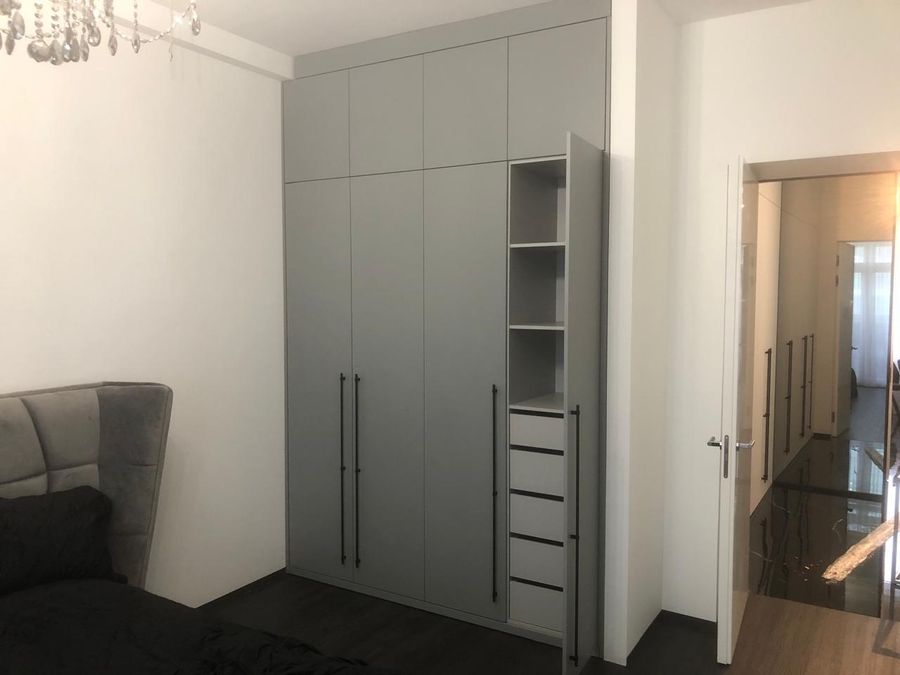
Custom-built built-in wardrobe combining closed storage with open sections for convenient everyday access and display. The design is integrated into the available wall space, providing efficient storage while maintaining a clean, modern appearance. Open compartments add visual depth and allow selected items, books, accessories, or decorative elements to remain easily accessible.
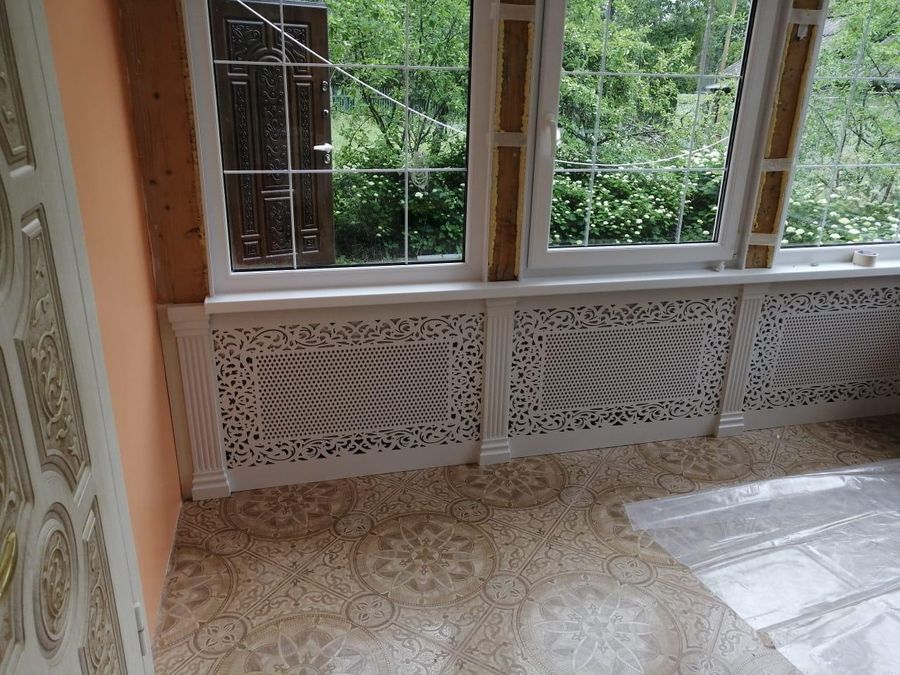
Custom-made decorative grilles designed to conceal heating radiators on a house veranda while maintaining proper airflow and heat circulation. The grilles combine practical functionality with a clean decorative appearance, integrating the heating elements into the overall interior design. The construction is made to fit the specific radiator dimensions and surrounding space.
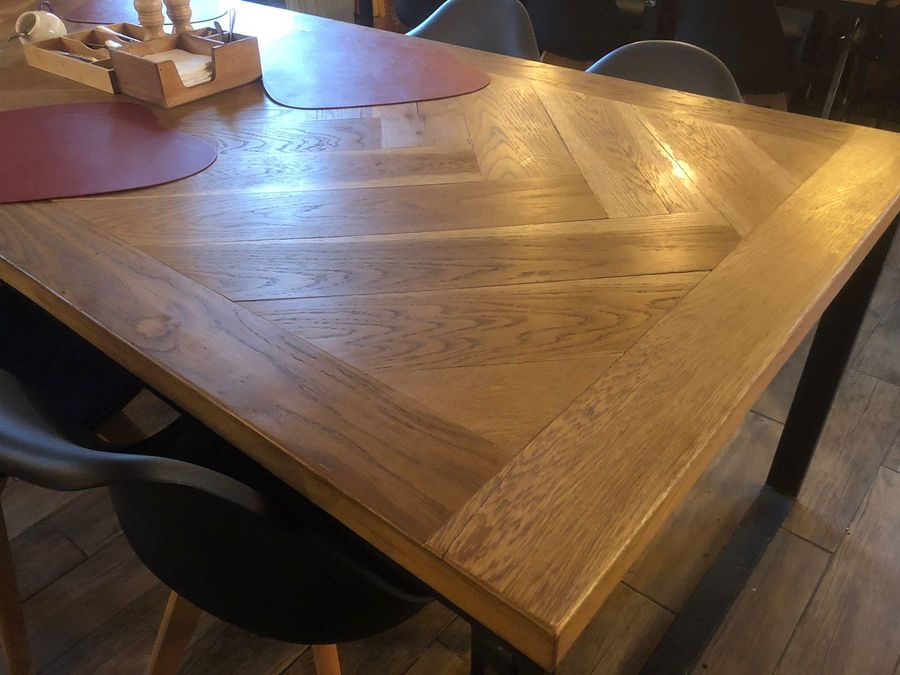
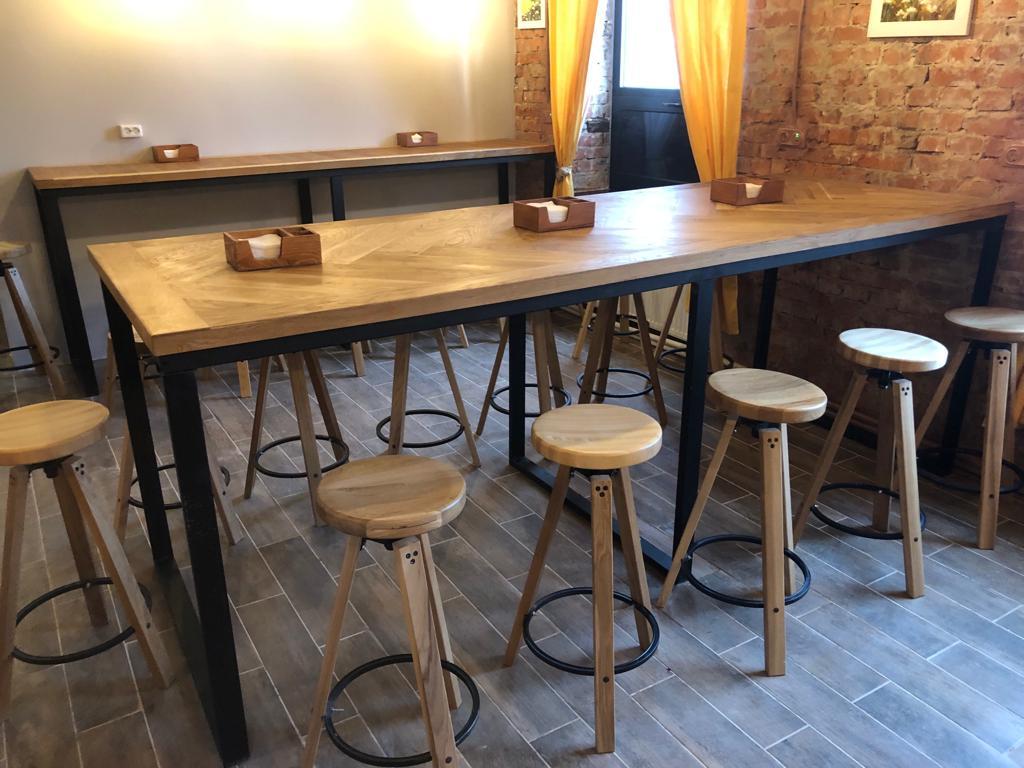
Custom-made wooden bar countertop designed for a residential or commercial interior. The countertop combines natural wood with a clean, functional design and is manufactured to fit the specific dimensions and layout of the space. Its solid construction and carefully finished surface provide both durability for everyday use and a refined architectural element within the interior.
Expert Insight
The core production challenge here was breadth, not depth. One workshop makes furniture, outdoor advertising, interior fit-out, POS equipment and decor, using 15 different materials. A single generic "laser cutting services" page cannot carry that. The site had to be organized the way the workshop actually works, material by material and process by process, or visitors and search engines would default back to a shallow, generic read of the business.
Splitting production (B2B) from decor retail (B2C) into two separate platforms matters for the same reason a factory floor is separated from a showroom: the buyers, the content, and the sales cycle are different, and merging them back into one site would have re-created the original clarity problem in a new form.
The five-year duration is itself the more instructive data point for other manufacturing businesses. A catalog this wide is not fixed by a single redesign, it is maintained through years of matching content and campaigns to what the workshop is actually capable of producing.
As buyers use AI assistants to shortlist fabrication shops, the links between material, process, and finished product are the structure that still transfers. Social channels in this record are not treated as an AI-ranking method.
About the Client
Laser Made is a full-cycle manufacturing company. Its own production facilities handle laser cutting, milling, painting and assembly, run by an in-house team of specialists. Materials worked on include wood, acrylic, MDF and metal. Output ranges from custom furniture and decorative items to advertising structures and souvenirs.
Before the project, the company had the equipment and the production capacity, but almost no visibility online.
Starting Point (2019)
The company ran on two WordPress landing pages. Both were slow and had no real structure. Design, production, equipment and services were all crammed onto the same page, so a visitor had no clear way to tell what the company actually did.
There was no portfolio and no case studies, only a plain list of services. SEO was effectively absent. Paid search spend was going nowhere. Social media accounts existed but were run without a plan and produced no measurable result.
What Was Built
Laser Made Gallery - Custom Design and Manufacturing Company
Information architecture of the Lasermade
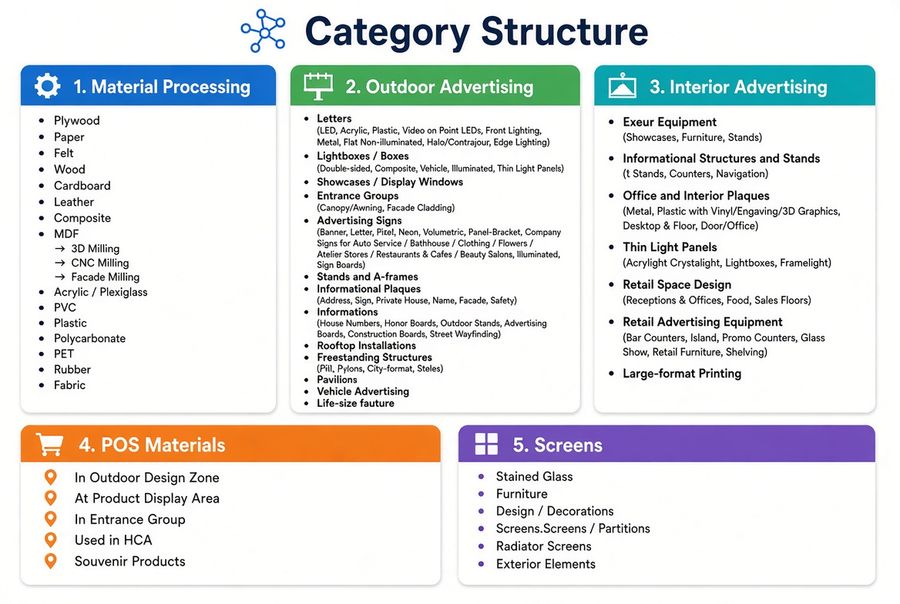
The WordPress landing pages were retired and the site was rebuilt on Drupal. The new structure was organized around the actual production process rather than a generic services list:
Material processing, 15 categories (plywood, wood, MDF, composite, acrylic, PVC, plastic, and others)
Outdoor advertising, 7 sections, from illuminated letters to roof-mounted installations
Interior advertising: exhibition equipment, wayfinding signage, retail space fit-out
POS materials and retail equipment
Screens, stained-glass elements, custom furniture, partitions
A portfolio section with 200+ documented projects, a press and blog center, and a dedicated client-resources section
A second, separate storefront, Decor Trend, was launched for retail decor sales. It runs as its own platform with its own audience and promotion approach: the corporate site (Laser Made) serves B2B, the store serves B2C.
The semantic core behind the new structure covers 2,000+ keywords, broken down by individual material, process and application (for example, distinguishing "MDF milling" from generic "laser cutting" queries).
Year 1: Foundation
New site built on Drupal from the ground up
15 material-processing categories defined: plywood, wood, MDF, acrylic, plastic, PVC, composite, polycarbonate, PET, paper, cardboard, felt, fabric, leather, rubber
7 outdoor-advertising sections defined: letters, boxes and lightboxes, signs, plaques, stands, large structures, entrance groups
Interior advertising, POS materials and retail-equipment sections built out
Semantic core collected and clustered (2,000+ queries)
Baseline PPC campaigns launched for early traffic
Analytics and conversion tracking configured
Years 2 to 3: Scaling
Optimized content written for each service and material category
Portfolio populated with 200+ real projects
Blog launched with expert articles, typically built from a 30-minute interview with the client turned into a roughly 2,000-word article
Decor Trend online store developed and launched
Link building through industry publications, mixing free guest posts on industry blogs with paid placements in directories and design and construction media
10+ social media channels actively managed, including VKontakte, YouTube, Odnoklassniki, Telegram, Pinterest, Twitter/X and Instagram, covering content planning, shooting and design
Jivo live chat integrated for instant client contact
Years 4 to 5: Optimization and Scaling
Ongoing A/B testing of ad copy and landing pages
CPC reduction through more precise audience targeting
Hundreds of keywords reaching Google top positions
Video content produced covering production processes, case examples and reviews
Workflow automation introduced from initial request through to production
Site Structure: From One Page to a System
Laser Made is organized into 27+ sections, grouped around six practical areas: material processing (15+ types, including 3D milling and CNC facade work), outdoor advertising (7 sections), interior advertising, POS and retail equipment, screens, furniture and decor, and a press-center plus client-resources area (blog, FAQ, free measurement and design requests, delivery information, layout requirements).
Representative portfolio pages referenced in the source material include a mirrored hallway wardrobe, an oak kitchen with countertop, a veneer bar counter for a cafe, a turnkey wine cellar, decorative radiator screens, ornamental cafe partitions, and wooden restaurant menus.
Decor Trend is a separate online store for finished home-decor items, aimed at retail (B2C) buyers rather than the B2B production clients served by the corporate site.
Gallery of the Decor Trend — Home Decor E-commerce Store
Information architecture of the website Decortrend
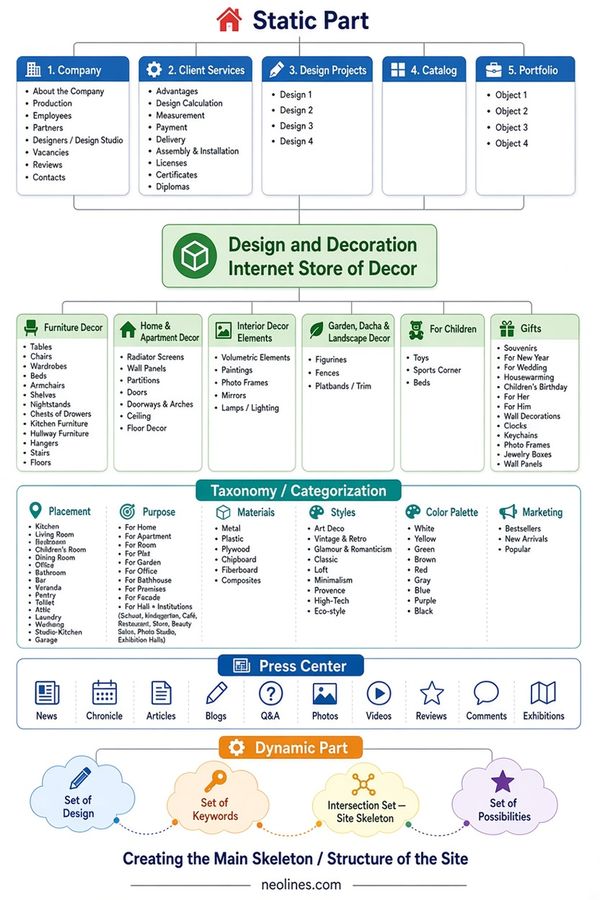
Frequently Asked Questions About Laser Made
The structure follows the production process, not a services menu. The 27+ sections on the corporate site are grouped into six practical areas: material processing, outdoor advertising, interior advertising, POS and retail equipment, screens and furniture and decor, and a press-center plus client-resources area.
Within material processing the 15 categories exist as their own destinations — plywood, wood, MDF, acrylic, plastic, PVC, composite, polycarbonate, PET, paper, cardboard, felt, fabric, leather and rubber. That matters because a buyer does not search for "laser cutting", they search for the material they hold in their hand. A single generic services page cannot answer that, and it also cannot rank for it.
Because the two audiences buy differently. The corporate site serves B2B clients commissioning custom production: they need technical detail, material and process specifics, and evidence of comparable work. The separate store serves B2C buyers of finished decor items, where the decision is short and visual.
Merging them re-creates the original problem in a new form — one page trying to speak to everyone, which is exactly what made the 2019 landing pages unreadable. Keeping them apart lets each platform have its own audience, content and promotion approach.
It buys specificity. The core is clustered by individual material, process and application rather than a small set of head terms, so "MDF milling" is treated as distinct from generic "laser cutting" demand. Each cluster then has a page that genuinely answers it.
The compounding effect showed up late: by years four and five, hundreds of keywords had reached top positions in Google. That is the honest shape of the result — not a step change after launch, but breadth accumulating over years as content matched what the workshop actually produces.
Several routes, deliberately matched to intent. A short name-and-phone form on the homepage captures fast enquiries. An extended form on service pages asks for service type, material and timeline, which qualifies the lead before anyone picks up the phone. A price calculator turns material and size into an estimate. Live chat accounts for roughly 15 to 20% of leads, on the condition that chats are answered within one to two minutes. WhatsApp and Telegram are offered as direct channels.
On channel mix, the source data gives an approximate split of about 50% from Google Ads, 30% from organic search, 15% from social media and 5% direct. That is presented as an estimate rather than an audited figure, and it is worth treating it as one.
Honest answer: no measured AI-search results are claimed for this project. What exists is the groundwork that AI answers tend to draw on — a structure that ties material to the processes performed on it and to the finished product categories that use it, a 200+ project portfolio, an expert blog built from client interviews, a project FAQ, and Google My Business reviews.
That is standard information-architecture and authority work rather than a dedicated generative-search programme. It positions the business to be described accurately by a system that reads structure, but claiming measured visibility in ChatGPT, Perplexity or Gemini for this engagement would be inventing a result.
Comments
Daniel HoffmanIndustrial marketing consultant The part I keep coming back to is the 15 material categories. Most fabricators I work with have the same breadth and they all end up with one "our services" page because nobody can agree how to divide it. How did you actually decide the six top-level groups rather than, say, splitting by machine?
Maryan PolyakExpertManufacturing Digital Marketing & Web Development Expert Splitting by machine is the trap, because it describes the workshop to itself rather than to a buyer. Nobody commissions "the CNC router". The six groups follow what the output is for: material processing, outdoor advertising, interior advertising, POS and retail equipment, screens and furniture and decor, and the client-resources area.
Material is the entry point because it is the one thing a buyer already knows before they know anything else. Process lives underneath it, which is why 3D milling and CNC facade work sit inside material processing rather than as peers of it.
Petra LindqvistTechnical SEO lead 2,000+ keywords across 27+ sections raises the obvious question: how did you avoid producing a field of thin near-duplicate pages? Material-by-material pages are notoriously easy to turn into doorway content.
Maryan PolyakExpertManufacturing Digital Marketing & Web Development Expert The clustering is what prevents it. A cluster only becomes a page if it has something specific to say — a material with its own tolerances, thicknesses, finishes and typical applications. Where two clusters would say the same thing, they belong on one page with the second as a section, not as a separate URL.
The other half is content that is not templated. Each service and material category got written content rather than a generated variant, and the portfolio carries 200+ documented projects that give those categories real examples to point at. A page with a real project on it is very hard to mistake for a doorway.
Petra LindqvistTechnical SEO lead And cannibalisation between the material pages and the process pages? "MDF" and "MDF milling" are close enough to compete.
Maryan PolyakExpertManufacturing Digital Marketing & Web Development Expert They are, and the resolution is hierarchy rather than keyword avoidance. The material page owns the material as a whole and links down; the process page owns the specific operation and links up. One is the category, one is the answer to a narrower query. Problems appear when both pages try to be the category — then you are competing with yourself and Google picks for you.
Ruben CastellanosWeb development studio owner Curious about the platform decision. Moving off WordPress to Drupal in 2019 for a fabrication business — what made that the right call rather than rebuilding on WordPress properly?
Maryan PolyakExpertManufacturing Digital Marketing & Web Development Expert The deciding factor was the structure itself. What had to be modelled was a taxonomy with real depth — materials, processes, applications and product categories that cross-reference each other — plus a portfolio that had to grow past 200 entries and stay navigable.
I would not present that as a universal verdict on the two platforms. The honest version is that the site was rebuilt from the ground up on Drupal and the structure held for five years without needing another rebuild, which is the outcome that actually mattered.
Ilana FischerB2B demand generation You describe two form types — a short one on the homepage and an extended one on service pages. In practice, did the longer form suppress volume? That is usually the objection from sales.
Maryan PolyakExpertManufacturing Digital Marketing & Web Development Expert It changes what you are optimising for. The short form exists precisely because some visitors will not fill in anything longer, so it stays as the low-friction route. The extended form asks for service type, material and timeline, and its job is qualification — those three answers tell you whether an enquiry is a real project before anyone spends time on it.
For custom production that trade is usually worth it, because the cost of an unqualified enquiry is a quote that takes real engineering time to prepare.
Ilana FischerB2B demand generation Where does the price calculator sit in that? I would expect a fabricator to resist publishing anything that looks like a price.
Maryan PolyakExpertManufacturing Digital Marketing & Web Development Expert It gives an estimate from material and size, not a quote, and that distinction is what makes it acceptable. Its real function is filtering: a visitor who sees the rough order of magnitude and continues is a different prospect from one who had no idea. It removes the conversation that ends at the number.
Tomasz WierzbickiPPC specialist, industrial accounts On the paid side — you mention an A/B test where a price-free emotional headline beat a price-led one by around 20% on CTR and conversion. Did that hold for the B2B production campaigns, or mainly the consumer decor side?
Maryan PolyakExpertManufacturing Digital Marketing & Web Development Expert I would not stretch that result further than it goes. It is one documented headline test, and the roughly 20% improvement applies to that test rather than to the account as a whole. Treating it as a rule about B2B versus B2C would be overreading a single comparison.
What is safe to generalise is the practice, not the finding: continuous A/B testing of headlines, images, descriptions and landing pages, with tighter audience targeting used to bring cost per click down over time. The starting point was paid search that was spending without direction, so the gain came from testing at all.
Tomasz WierzbickiPPC specialist, industrial accounts Fair. Did the segmented site structure change what you could do in the ad account?
Maryan PolyakExpertManufacturing Digital Marketing & Web Development Expert Significantly, and this is the part that gets missed. Ad groups can only be as specific as the page they land on. With one generic services page every keyword lands in the same place, so match quality is capped no matter how well the account is built. Once each material and process has a real destination, the campaign can mirror the structure instead of fighting it.
Noa BergerExport manager, metal fabrication We are looking at a similar rebuild but with three languages from the start. Did this project run multilingual, and would you sequence it differently knowing what you know?
Maryan PolyakExpertManufacturing Digital Marketing & Web Development Expert This engagement was single-language, so I cannot offer you measured results from it on the multilingual side. I would rather say that plainly than generalise from a project that did not test it.
What does transfer is the sequencing risk. The expensive mistake here would be translating a structure you are not yet sure about. The material, process and application hierarchy took real work to get right, and every language multiplies the cost of changing it later. Settling the architecture in one language first is the cheaper order of operations.
Marek DoležalContent strategist The blog model interests me — roughly a 30-minute client interview turned into a ~2,000-word article. How do you keep that going for years without the client losing patience with it?
Maryan PolyakExpertManufacturing Digital Marketing & Web Development Expert By keeping their side of it to the 30 minutes. The interview is the only thing that needs the client, because it is the only part that cannot be sourced elsewhere — how they actually solved a specific job. Writing, editing and publishing do not involve them.
The cadence was front-loaded: 10 to 15 foundational articles first, then 2 to 4 a month. That ordering matters, because the foundational set is what the category pages link into. Starting with a monthly drip leaves the structure with nothing to support it.
Marek DoležalContent strategist Did the interview-led articles do anything for trust beyond search traffic?
Maryan PolyakExpertManufacturing Digital Marketing & Web Development Expert That is arguably their main job. A buyer commissioning custom production is trying to establish competence before they make contact, and an article that explains how a specific problem was solved does that better than a capability list. Together with the portfolio and the project FAQ, it means the case for the company is already made before the first call.
Grace OyelaranFrontend performance engineer The original landing pages are described as slow. Where did the rebuilt site land on performance, and how much of that was structural versus asset-level work?
Maryan PolyakExpertManufacturing Digital Marketing & Web Development Expert The figures recorded for this project are roughly 1.5 to 2 seconds on desktop, 2.5 to 3 seconds on mobile, and a Google PageSpeed score in the 85 to 90 range. For a portfolio-heavy manufacturing site that is a reasonable place to be.
Most of it is asset-level — a site showing 200+ documented projects lives and dies by image handling. But some is structural: when a visitor can reach the specific material they came for in one step, they load one relevant page instead of hunting through a page that carries everything.
Sven AaltonenHead of digital, contract manufacturing Everyone is now asking whether their site is "AI-search ready". Given this structure, do you see evidence that it helps in generative answers, or is that still speculation?
Maryan PolyakExpertManufacturing Digital Marketing & Web Development Expert For this project it is speculation, and I will not dress it up. Nothing in the engagement measured visibility in AI answer engines, so there is no result to report.
What I will say is that the work that makes a site legible to an AI system is not a separate discipline. Explicit entities, a material linked to the processes performed on it and to the product categories that use it, a clear split between the B2B production business and the B2C store, documented projects, reviews — that is the same information architecture and authority work you would do anyway. If generative search rewards it, this site is positioned for it. That is a different sentence from claiming it already has.
Adela MarchettiMarketing director, furniture manufacturing What stands out is the five years rather than any single number. Most agencies would have presented this as a redesign case. Was the long engagement a deliberate model or just how it turned out?
Maryan PolyakExpertManufacturing Digital Marketing & Web Development Expert It is the finding, not the framing. A catalogue this wide is not fixed by a redesign, because the work is keeping content and campaigns matched to what the workshop can actually produce — and that changes. The five years cover a Drupal rebuild, the semantic core, the portfolio, a second platform for retail, 10+ social channels, then years of testing and automation from enquiry through to production.
I would rather present that than a growth percentage. Manufacturers are, in my experience, the audience least impressed by a chart and most interested in whether something is still working after year three.
Have a question about this topic?
Send your question to Maryan Polyak. Relevant questions may be answered in a future expert discussion.
- Manufacturing Website Development
- Manufacturing Website Design & Development
- Manufacturing SEO
- Paid Search & Paid Media
- Technical Content Marketing
- Website Conversion & RFQ Optimization
- Laser Cutting
- Custom Furniture Manufacturing
- Custom Wood Products
- Custom Retail Equipment
- Laser Cutting
- CNC Milling
- Digital Customer Acquisition
- E-commerce Growth
- Lead Generation & New Business
- Furniture Manufacturing